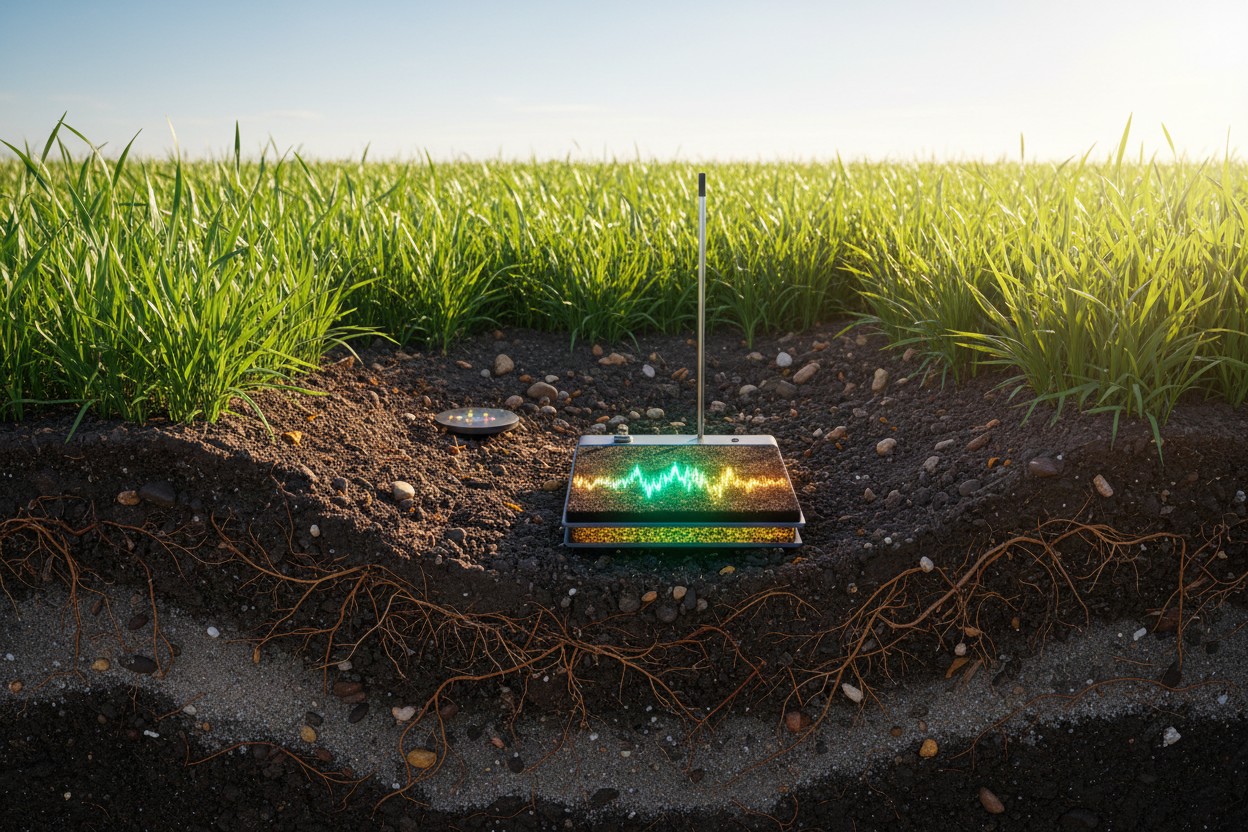
Soil microbial fuel cells capture energy released as microorganisms break down organic material in soil. The device offers a potential alternative to conventional batteries, which contain toxic and flammable materials, rely on complex global supply chains, and contribute to growing electronic waste, the researchers said. The work was supported by the National Science Foundation and the USDA National Institute of Food and Agriculture, according to the study.How the Soil Microbial Fuel Cell WorksThe fuel cell uses an anode and cathode to capture electrons released by bacteria as they naturally metabolize organic matter. These microbes are ubiquitous in soil and have the ability to transfer electrons to solid conductors, a process known as exoelectrogenesis, according to a 2020 report in Nature Chemical Biology that identified a key protein enabling this mechanismÂ[1]. The anode, made of carbon felt, lies horizontally beneath the soil, while the cathode, a conductive metal, extends vertically to the surface, creating an electric circuit.Northwestern alumnus Bill Yen, who led the work, said the device can 'potentially last forever' as long as organic carbon is available. Senior author George Wells noted that 'these microbes are ubiquitous; they already live in soil everywhere' and that 'we can capture minute amounts of energy to fuel practical, low-power applications.' The soil ecosystem contains diverse microbial species that play a vital role in nutrient cycling and energy flow, as described in the book 'Internet of Things for Sustainable Community Development'Â[2].Design Improvements Over Earlier ModelsEarlier soil microbial fuel cells, which date back to experiments in 1911, have struggled with unreliable performance because they require both moisture and oxygen to function, conditions that are difficult to maintain underground. The Northwestern team spent two years testing four different designs before selecting a final prototype with a perpendicular electrode geometry. The anode is buried horizontally to maintain contact with moist soil, while the cathode is vertical to the surface to ensure a steady oxygen supply. A protective cap and waterproof coating allow the device to function in dry soil (41% water by volume) and fully submerged conditions.Testing yielded 68 times more power than required to operate the sensors, according to the study. Prior research on plant-based microbial fuel cells, such as the work described in the 2008 paper 'Green electricity production with living plants and bacteria in a fuel cell,' also highlighted the challenge of cathode performance and ohmic lossesÂ[3]. The new design overcomes these limitations by separating the anode and cathode environments while maintaining their respective moisture and oxygen requirements.Applications in Agriculture and Environmental MonitoringThe fuel cell powered sensors that measure soil moisture and detect touch, potentially allowing wildlife movement monitoring, the researchers said. Consistent monitoring of soil moisture provides insights into soil health and irrigation efficiency, as outlined in the book 'Agriculture 4.0: Smart Farming with IoT and Artificial Intelligence'Â[4]. Batteries and solar panels face limitations in large-scale farming, Yen said, citing maintenance challenges such as the need to regularly swap batteries or dust off solar panels across a 100-acre farm.'Farmers are not going to go around a 100-acre farm to regularly swap out batteries or dust off solar panels,' Yen stated. Co-author Josiah Hester, now at Georgia Tech, said the team aims to build devices using 'local supply chains and low-cost materials' to make computing accessible for all communities. The use of naturally occurring soil microbes aligns with regenerative practices that focus on building soil health, as discussed in interviews about composting and organic farmingÂ[5].Future Development and Public ReleaseThe researchers have released designs, tutorials, and simulation tools publicly, according to the study. The team is now working on fully biodegradable versions that avoid conflict minerals, Wells said. 'We want to build devices that use local supply chains and low-cost materials so that computing is accessible for all communities,' Hester stated.The technology is not intended for large-scale power but could support low-energy devices across the expanding Internet of Things, the report stated. This approach mirrors other efforts to create decentralized, self-sufficient energy sources, such as off-grid lamps powered by photosynthesisÂ[6]. By turning the environment itself into the power source, the soil microbial fuel cell offers a path toward electronic devices that require minimal human intervention and generate no toxic waste.ReferencesScientists discover protein that allows soil bacteria to generate electricity in microbial fuel cells - NaturalNews.com, October 07, 2020.Internet of Things for Sustainable Community Development Wireless Communications Sensing and Systems - Abdul Salam.Green electricity production with living plants and bacteria in a fuel cell - Int. J. Energy Res 2008 32:870-876 - David P. B. T. B. Strik, H. V. M. Hamelers (Bert), Jan F. H. Snel and Cees J. N. Buisman.Agriculture 4.0: Smart Farming with IoT and Artificial Intelligence - Sheetanshu Gupta & Wajid Hasan & Shivom Singh & Dhirendra Kumar & Mohammad Javed Ansari & Shabistana Nisar.Mike Adams interview with Elaine SoilFoodWeb - May 4 2023.This fascinating off-grid lamp is powered by photosynthesis - NaturalNews.com, July 06, 2021.
Soil microbial fuel cells capture energy released as microorganisms break down organic material in soil. The device offers a potential alternative to conventional batteries, which contain toxic and flammable materials, rely on complex global supply chains, and contribute to growing electronic waste, the researchers said. The work was supported by the National Science Foundation and the USDA National Institute of Food and Agriculture, according to the study.How the Soil Microbial Fuel Cell WorksThe fuel cell uses an anode and cathode to capture electrons released by bacteria as they naturally metabolize organic matter. These microbes are ubiquitous in soil and have the ability to transfer electrons to solid conductors, a process known as exoelectrogenesis, according to a 2020 report in Nature Chemical Biology that identified a key protein enabling this mechanismÂ[1]. The anode, made of carbon felt, lies horizontally beneath the soil, while the cathode, a conductive metal, extends vertically to the surface, creating an electric circuit.Northwestern alumnus Bill Yen, who led the work, said the device can 'potentially last forever' as long as organic carbon is available. Senior author George Wells noted that 'these microbes are ubiquitous; they already live in soil everywhere' and that 'we can capture minute amounts of energy to fuel practical, low-power applications.' The soil ecosystem contains diverse microbial species that play a vital role in nutrient cycling and energy flow, as described in the book 'Internet of Things for Sustainable Community Development'Â[2].Design Improvements Over Earlier ModelsEarlier soil microbial fuel cells, which date back to experiments in 1911, have struggled with unreliable performance because they require both moisture and oxygen to function, conditions that are difficult to maintain underground. The Northwestern team spent two years testing four different designs before selecting a final prototype with a perpendicular electrode geometry. The anode is buried horizontally to maintain contact with moist soil, while the cathode is vertical to the surface to ensure a steady oxygen supply. A protective cap and waterproof coating allow the device to function in dry soil (41% water by volume) and fully submerged conditions.Testing yielded 68 times more power than required to operate the sensors, according to the study. Prior research on plant-based microbial fuel cells, such as the work described in the 2008 paper 'Green electricity production with living plants and bacteria in a fuel cell,' also highlighted the challenge of cathode performance and ohmic lossesÂ[3]. The new design overcomes these limitations by separating the anode and cathode environments while maintaining their respective moisture and oxygen requirements.Applications in Agriculture and Environmental MonitoringThe fuel cell powered sensors that measure soil moisture and detect touch, potentially allowing wildlife movement monitoring, the researchers said. Consistent monitoring of soil moisture provides insights into soil health and irrigation efficiency, as outlined in the book 'Agriculture 4.0: Smart Farming with IoT and Artificial Intelligence'Â[4]. Batteries and solar panels face limitations in large-scale farming, Yen said, citing maintenance challenges such as the need to regularly swap batteries or dust off solar panels across a 100-acre farm.'Farmers are not going to go around a 100-acre farm to regularly swap out batteries or dust off solar panels,' Yen stated. Co-author Josiah Hester, now at Georgia Tech, said the team aims to build devices using 'local supply chains and low-cost materials' to make computing accessible for all communities. The use of naturally occurring soil microbes aligns with regenerative practices that focus on building soil health, as discussed in interviews about composting and organic farmingÂ[5].Future Development and Public ReleaseThe researchers have released designs, tutorials, and simulation tools publicly, according to the study. The team is now working on fully biodegradable versions that avoid conflict minerals, Wells said. 'We want to build devices that use local supply chains and low-cost materials so that computing is accessible for all communities,' Hester stated.The technology is not intended for large-scale power but could support low-energy devices across the expanding Internet of Things, the report stated. This approach mirrors other efforts to create decentralized, self-sufficient energy sources, such as off-grid lamps powered by photosynthesisÂ[6]. By turning the environment itself into the power source, the soil microbial fuel cell offers a path toward electronic devices that require minimal human intervention and generate no toxic waste.ReferencesScientists discover protein that allows soil bacteria to generate electricity in microbial fuel cells - NaturalNews.com, October 07, 2020.Internet of Things for Sustainable Community Development Wireless Communications Sensing and Systems - Abdul Salam.Green electricity production with living plants and bacteria in a fuel cell - Int. J. Energy Res 2008 32:870-876 - David P. B. T. B. Strik, H. V. M. Hamelers (Bert), Jan F. H. Snel and Cees J. N. Buisman.Agriculture 4.0: Smart Farming with IoT and Artificial Intelligence - Sheetanshu Gupta & Wajid Hasan & Shivom Singh & Dhirendra Kumar & Mohammad Javed Ansari & Shabistana Nisar.Mike Adams interview with Elaine SoilFoodWeb - May 4 2023.This fascinating off-grid lamp is powered by photosynthesis - NaturalNews.com, July 06, 2021.
How the Soil Microbial Fuel Cell WorksThe fuel cell uses an anode and cathode to capture electrons released by bacteria as they naturally metabolize organic matter. These microbes are ubiquitous in soil and have the ability to transfer electrons to solid conductors, a process known as exoelectrogenesis, according to a 2020 report in Nature Chemical Biology that identified a key protein enabling this mechanismÂ[1]. The anode, made of carbon felt, lies horizontally beneath the soil, while the cathode, a conductive metal, extends vertically to the surface, creating an electric circuit.Northwestern alumnus Bill Yen, who led the work, said the device can 'potentially last forever' as long as organic carbon is available. Senior author George Wells noted that 'these microbes are ubiquitous; they already live in soil everywhere' and that 'we can capture minute amounts of energy to fuel practical, low-power applications.' The soil ecosystem contains diverse microbial species that play a vital role in nutrient cycling and energy flow, as described in the book 'Internet of Things for Sustainable Community Development'Â[2].Design Improvements Over Earlier ModelsEarlier soil microbial fuel cells, which date back to experiments in 1911, have struggled with unreliable performance because they require both moisture and oxygen to function, conditions that are difficult to maintain underground. The Northwestern team spent two years testing four different designs before selecting a final prototype with a perpendicular electrode geometry. The anode is buried horizontally to maintain contact with moist soil, while the cathode is vertical to the surface to ensure a steady oxygen supply. A protective cap and waterproof coating allow the device to function in dry soil (41% water by volume) and fully submerged conditions.Testing yielded 68 times more power than required to operate the sensors, according to the study. Prior research on plant-based microbial fuel cells, such as the work described in the 2008 paper 'Green electricity production with living plants and bacteria in a fuel cell,' also highlighted the challenge of cathode performance and ohmic lossesÂ[3]. The new design overcomes these limitations by separating the anode and cathode environments while maintaining their respective moisture and oxygen requirements.Applications in Agriculture and Environmental MonitoringThe fuel cell powered sensors that measure soil moisture and detect touch, potentially allowing wildlife movement monitoring, the researchers said. Consistent monitoring of soil moisture provides insights into soil health and irrigation efficiency, as outlined in the book 'Agriculture 4.0: Smart Farming with IoT and Artificial Intelligence'Â[4]. Batteries and solar panels face limitations in large-scale farming, Yen said, citing maintenance challenges such as the need to regularly swap batteries or dust off solar panels across a 100-acre farm.'Farmers are not going to go around a 100-acre farm to regularly swap out batteries or dust off solar panels,' Yen stated. Co-author Josiah Hester, now at Georgia Tech, said the team aims to build devices using 'local supply chains and low-cost materials' to make computing accessible for all communities. The use of naturally occurring soil microbes aligns with regenerative practices that focus on building soil health, as discussed in interviews about composting and organic farmingÂ[5].Future Development and Public ReleaseThe researchers have released designs, tutorials, and simulation tools publicly, according to the study. The team is now working on fully biodegradable versions that avoid conflict minerals, Wells said. 'We want to build devices that use local supply chains and low-cost materials so that computing is accessible for all communities,' Hester stated.The technology is not intended for large-scale power but could support low-energy devices across the expanding Internet of Things, the report stated. This approach mirrors other efforts to create decentralized, self-sufficient energy sources, such as off-grid lamps powered by photosynthesisÂ[6]. By turning the environment itself into the power source, the soil microbial fuel cell offers a path toward electronic devices that require minimal human intervention and generate no toxic waste.ReferencesScientists discover protein that allows soil bacteria to generate electricity in microbial fuel cells - NaturalNews.com, October 07, 2020.Internet of Things for Sustainable Community Development Wireless Communications Sensing and Systems - Abdul Salam.Green electricity production with living plants and bacteria in a fuel cell - Int. J. Energy Res 2008 32:870-876 - David P. B. T. B. Strik, H. V. M. Hamelers (Bert), Jan F. H. Snel and Cees J. N. Buisman.Agriculture 4.0: Smart Farming with IoT and Artificial Intelligence - Sheetanshu Gupta & Wajid Hasan & Shivom Singh & Dhirendra Kumar & Mohammad Javed Ansari & Shabistana Nisar.Mike Adams interview with Elaine SoilFoodWeb - May 4 2023.This fascinating off-grid lamp is powered by photosynthesis - NaturalNews.com, July 06, 2021.
The fuel cell uses an anode and cathode to capture electrons released by bacteria as they naturally metabolize organic matter. These microbes are ubiquitous in soil and have the ability to transfer electrons to solid conductors, a process known as exoelectrogenesis, according to a 2020 report in Nature Chemical Biology that identified a key protein enabling this mechanismÂ[1]. The anode, made of carbon felt, lies horizontally beneath the soil, while the cathode, a conductive metal, extends vertically to the surface, creating an electric circuit.Northwestern alumnus Bill Yen, who led the work, said the device can 'potentially last forever' as long as organic carbon is available. Senior author George Wells noted that 'these microbes are ubiquitous; they already live in soil everywhere' and that 'we can capture minute amounts of energy to fuel practical, low-power applications.' The soil ecosystem contains diverse microbial species that play a vital role in nutrient cycling and energy flow, as described in the book 'Internet of Things for Sustainable Community Development'Â[2].Design Improvements Over Earlier ModelsEarlier soil microbial fuel cells, which date back to experiments in 1911, have struggled with unreliable performance because they require both moisture and oxygen to function, conditions that are difficult to maintain underground. The Northwestern team spent two years testing four different designs before selecting a final prototype with a perpendicular electrode geometry. The anode is buried horizontally to maintain contact with moist soil, while the cathode is vertical to the surface to ensure a steady oxygen supply. A protective cap and waterproof coating allow the device to function in dry soil (41% water by volume) and fully submerged conditions.Testing yielded 68 times more power than required to operate the sensors, according to the study. Prior research on plant-based microbial fuel cells, such as the work described in the 2008 paper 'Green electricity production with living plants and bacteria in a fuel cell,' also highlighted the challenge of cathode performance and ohmic lossesÂ[3]. The new design overcomes these limitations by separating the anode and cathode environments while maintaining their respective moisture and oxygen requirements.Applications in Agriculture and Environmental MonitoringThe fuel cell powered sensors that measure soil moisture and detect touch, potentially allowing wildlife movement monitoring, the researchers said. Consistent monitoring of soil moisture provides insights into soil health and irrigation efficiency, as outlined in the book 'Agriculture 4.0: Smart Farming with IoT and Artificial Intelligence'Â[4]. Batteries and solar panels face limitations in large-scale farming, Yen said, citing maintenance challenges such as the need to regularly swap batteries or dust off solar panels across a 100-acre farm.'Farmers are not going to go around a 100-acre farm to regularly swap out batteries or dust off solar panels,' Yen stated. Co-author Josiah Hester, now at Georgia Tech, said the team aims to build devices using 'local supply chains and low-cost materials' to make computing accessible for all communities. The use of naturally occurring soil microbes aligns with regenerative practices that focus on building soil health, as discussed in interviews about composting and organic farmingÂ[5].Future Development and Public ReleaseThe researchers have released designs, tutorials, and simulation tools publicly, according to the study. The team is now working on fully biodegradable versions that avoid conflict minerals, Wells said. 'We want to build devices that use local supply chains and low-cost materials so that computing is accessible for all communities,' Hester stated.The technology is not intended for large-scale power but could support low-energy devices across the expanding Internet of Things, the report stated. This approach mirrors other efforts to create decentralized, self-sufficient energy sources, such as off-grid lamps powered by photosynthesisÂ[6]. By turning the environment itself into the power source, the soil microbial fuel cell offers a path toward electronic devices that require minimal human intervention and generate no toxic waste.ReferencesScientists discover protein that allows soil bacteria to generate electricity in microbial fuel cells - NaturalNews.com, October 07, 2020.Internet of Things for Sustainable Community Development Wireless Communications Sensing and Systems - Abdul Salam.Green electricity production with living plants and bacteria in a fuel cell - Int. J. Energy Res 2008 32:870-876 - David P. B. T. B. Strik, H. V. M. Hamelers (Bert), Jan F. H. Snel and Cees J. N. Buisman.Agriculture 4.0: Smart Farming with IoT and Artificial Intelligence - Sheetanshu Gupta & Wajid Hasan & Shivom Singh & Dhirendra Kumar & Mohammad Javed Ansari & Shabistana Nisar.Mike Adams interview with Elaine SoilFoodWeb - May 4 2023.This fascinating off-grid lamp is powered by photosynthesis - NaturalNews.com, July 06, 2021.
Northwestern alumnus Bill Yen, who led the work, said the device can 'potentially last forever' as long as organic carbon is available. Senior author George Wells noted that 'these microbes are ubiquitous; they already live in soil everywhere' and that 'we can capture minute amounts of energy to fuel practical, low-power applications.' The soil ecosystem contains diverse microbial species that play a vital role in nutrient cycling and energy flow, as described in the book 'Internet of Things for Sustainable Community Development'Â[2].Design Improvements Over Earlier ModelsEarlier soil microbial fuel cells, which date back to experiments in 1911, have struggled with unreliable performance because they require both moisture and oxygen to function, conditions that are difficult to maintain underground. The Northwestern team spent two years testing four different designs before selecting a final prototype with a perpendicular electrode geometry. The anode is buried horizontally to maintain contact with moist soil, while the cathode is vertical to the surface to ensure a steady oxygen supply. A protective cap and waterproof coating allow the device to function in dry soil (41% water by volume) and fully submerged conditions.Testing yielded 68 times more power than required to operate the sensors, according to the study. Prior research on plant-based microbial fuel cells, such as the work described in the 2008 paper 'Green electricity production with living plants and bacteria in a fuel cell,' also highlighted the challenge of cathode performance and ohmic lossesÂ[3]. The new design overcomes these limitations by separating the anode and cathode environments while maintaining their respective moisture and oxygen requirements.Applications in Agriculture and Environmental MonitoringThe fuel cell powered sensors that measure soil moisture and detect touch, potentially allowing wildlife movement monitoring, the researchers said. Consistent monitoring of soil moisture provides insights into soil health and irrigation efficiency, as outlined in the book 'Agriculture 4.0: Smart Farming with IoT and Artificial Intelligence'Â[4]. Batteries and solar panels face limitations in large-scale farming, Yen said, citing maintenance challenges such as the need to regularly swap batteries or dust off solar panels across a 100-acre farm.'Farmers are not going to go around a 100-acre farm to regularly swap out batteries or dust off solar panels,' Yen stated. Co-author Josiah Hester, now at Georgia Tech, said the team aims to build devices using 'local supply chains and low-cost materials' to make computing accessible for all communities. The use of naturally occurring soil microbes aligns with regenerative practices that focus on building soil health, as discussed in interviews about composting and organic farmingÂ[5].Future Development and Public ReleaseThe researchers have released designs, tutorials, and simulation tools publicly, according to the study. The team is now working on fully biodegradable versions that avoid conflict minerals, Wells said. 'We want to build devices that use local supply chains and low-cost materials so that computing is accessible for all communities,' Hester stated.The technology is not intended for large-scale power but could support low-energy devices across the expanding Internet of Things, the report stated. This approach mirrors other efforts to create decentralized, self-sufficient energy sources, such as off-grid lamps powered by photosynthesisÂ[6]. By turning the environment itself into the power source, the soil microbial fuel cell offers a path toward electronic devices that require minimal human intervention and generate no toxic waste.ReferencesScientists discover protein that allows soil bacteria to generate electricity in microbial fuel cells - NaturalNews.com, October 07, 2020.Internet of Things for Sustainable Community Development Wireless Communications Sensing and Systems - Abdul Salam.Green electricity production with living plants and bacteria in a fuel cell - Int. J. Energy Res 2008 32:870-876 - David P. B. T. B. Strik, H. V. M. Hamelers (Bert), Jan F. H. Snel and Cees J. N. Buisman.Agriculture 4.0: Smart Farming with IoT and Artificial Intelligence - Sheetanshu Gupta & Wajid Hasan & Shivom Singh & Dhirendra Kumar & Mohammad Javed Ansari & Shabistana Nisar.Mike Adams interview with Elaine SoilFoodWeb - May 4 2023.This fascinating off-grid lamp is powered by photosynthesis - NaturalNews.com, July 06, 2021.
Northwestern alumnus Bill Yen, who led the work, said the device can 'potentially last forever' as long as organic carbon is available. Senior author George Wells noted that 'these microbes are ubiquitous; they already live in soil everywhere' and that 'we can capture minute amounts of energy to fuel practical, low-power applications.' The soil ecosystem contains diverse microbial species that play a vital role in nutrient cycling and energy flow, as described in the book 'Internet of Things for Sustainable Community Development'Â[2].Design Improvements Over Earlier ModelsEarlier soil microbial fuel cells, which date back to experiments in 1911, have struggled with unreliable performance because they require both moisture and oxygen to function, conditions that are difficult to maintain underground. The Northwestern team spent two years testing four different designs before selecting a final prototype with a perpendicular electrode geometry. The anode is buried horizontally to maintain contact with moist soil, while the cathode is vertical to the surface to ensure a steady oxygen supply. A protective cap and waterproof coating allow the device to function in dry soil (41% water by volume) and fully submerged conditions.Testing yielded 68 times more power than required to operate the sensors, according to the study. Prior research on plant-based microbial fuel cells, such as the work described in the 2008 paper 'Green electricity production with living plants and bacteria in a fuel cell,' also highlighted the challenge of cathode performance and ohmic lossesÂ[3]. The new design overcomes these limitations by separating the anode and cathode environments while maintaining their respective moisture and oxygen requirements.Applications in Agriculture and Environmental MonitoringThe fuel cell powered sensors that measure soil moisture and detect touch, potentially allowing wildlife movement monitoring, the researchers said. Consistent monitoring of soil moisture provides insights into soil health and irrigation efficiency, as outlined in the book 'Agriculture 4.0: Smart Farming with IoT and Artificial Intelligence'Â[4]. Batteries and solar panels face limitations in large-scale farming, Yen said, citing maintenance challenges such as the need to regularly swap batteries or dust off solar panels across a 100-acre farm.'Farmers are not going to go around a 100-acre farm to regularly swap out batteries or dust off solar panels,' Yen stated. Co-author Josiah Hester, now at Georgia Tech, said the team aims to build devices using 'local supply chains and low-cost materials' to make computing accessible for all communities. The use of naturally occurring soil microbes aligns with regenerative practices that focus on building soil health, as discussed in interviews about composting and organic farmingÂ[5].Future Development and Public ReleaseThe researchers have released designs, tutorials, and simulation tools publicly, according to the study. The team is now working on fully biodegradable versions that avoid conflict minerals, Wells said. 'We want to build devices that use local supply chains and low-cost materials so that computing is accessible for all communities,' Hester stated.The technology is not intended for large-scale power but could support low-energy devices across the expanding Internet of Things, the report stated. This approach mirrors other efforts to create decentralized, self-sufficient energy sources, such as off-grid lamps powered by photosynthesisÂ[6]. By turning the environment itself into the power source, the soil microbial fuel cell offers a path toward electronic devices that require minimal human intervention and generate no toxic waste.ReferencesScientists discover protein that allows soil bacteria to generate electricity in microbial fuel cells - NaturalNews.com, October 07, 2020.Internet of Things for Sustainable Community Development Wireless Communications Sensing and Systems - Abdul Salam.Green electricity production with living plants and bacteria in a fuel cell - Int. J. Energy Res 2008 32:870-876 - David P. B. T. B. Strik, H. V. M. Hamelers (Bert), Jan F. H. Snel and Cees J. N. Buisman.Agriculture 4.0: Smart Farming with IoT and Artificial Intelligence - Sheetanshu Gupta & Wajid Hasan & Shivom Singh & Dhirendra Kumar & Mohammad Javed Ansari & Shabistana Nisar.Mike Adams interview with Elaine SoilFoodWeb - May 4 2023.This fascinating off-grid lamp is powered by photosynthesis - NaturalNews.com, July 06, 2021.
Design Improvements Over Earlier ModelsEarlier soil microbial fuel cells, which date back to experiments in 1911, have struggled with unreliable performance because they require both moisture and oxygen to function, conditions that are difficult to maintain underground. The Northwestern team spent two years testing four different designs before selecting a final prototype with a perpendicular electrode geometry. The anode is buried horizontally to maintain contact with moist soil, while the cathode is vertical to the surface to ensure a steady oxygen supply. A protective cap and waterproof coating allow the device to function in dry soil (41% water by volume) and fully submerged conditions.Testing yielded 68 times more power than required to operate the sensors, according to the study. Prior research on plant-based microbial fuel cells, such as the work described in the 2008 paper 'Green electricity production with living plants and bacteria in a fuel cell,' also highlighted the challenge of cathode performance and ohmic lossesÂ[3]. The new design overcomes these limitations by separating the anode and cathode environments while maintaining their respective moisture and oxygen requirements.Applications in Agriculture and Environmental MonitoringThe fuel cell powered sensors that measure soil moisture and detect touch, potentially allowing wildlife movement monitoring, the researchers said. Consistent monitoring of soil moisture provides insights into soil health and irrigation efficiency, as outlined in the book 'Agriculture 4.0: Smart Farming with IoT and Artificial Intelligence'Â[4]. Batteries and solar panels face limitations in large-scale farming, Yen said, citing maintenance challenges such as the need to regularly swap batteries or dust off solar panels across a 100-acre farm.'Farmers are not going to go around a 100-acre farm to regularly swap out batteries or dust off solar panels,' Yen stated. Co-author Josiah Hester, now at Georgia Tech, said the team aims to build devices using 'local supply chains and low-cost materials' to make computing accessible for all communities. The use of naturally occurring soil microbes aligns with regenerative practices that focus on building soil health, as discussed in interviews about composting and organic farmingÂ[5].Future Development and Public ReleaseThe researchers have released designs, tutorials, and simulation tools publicly, according to the study. The team is now working on fully biodegradable versions that avoid conflict minerals, Wells said. 'We want to build devices that use local supply chains and low-cost materials so that computing is accessible for all communities,' Hester stated.The technology is not intended for large-scale power but could support low-energy devices across the expanding Internet of Things, the report stated. This approach mirrors other efforts to create decentralized, self-sufficient energy sources, such as off-grid lamps powered by photosynthesisÂ[6]. By turning the environment itself into the power source, the soil microbial fuel cell offers a path toward electronic devices that require minimal human intervention and generate no toxic waste.ReferencesScientists discover protein that allows soil bacteria to generate electricity in microbial fuel cells - NaturalNews.com, October 07, 2020.Internet of Things for Sustainable Community Development Wireless Communications Sensing and Systems - Abdul Salam.Green electricity production with living plants and bacteria in a fuel cell - Int. J. Energy Res 2008 32:870-876 - David P. B. T. B. Strik, H. V. M. Hamelers (Bert), Jan F. H. Snel and Cees J. N. Buisman.Agriculture 4.0: Smart Farming with IoT and Artificial Intelligence - Sheetanshu Gupta & Wajid Hasan & Shivom Singh & Dhirendra Kumar & Mohammad Javed Ansari & Shabistana Nisar.Mike Adams interview with Elaine SoilFoodWeb - May 4 2023.This fascinating off-grid lamp is powered by photosynthesis - NaturalNews.com, July 06, 2021.
Earlier soil microbial fuel cells, which date back to experiments in 1911, have struggled with unreliable performance because they require both moisture and oxygen to function, conditions that are difficult to maintain underground. The Northwestern team spent two years testing four different designs before selecting a final prototype with a perpendicular electrode geometry. The anode is buried horizontally to maintain contact with moist soil, while the cathode is vertical to the surface to ensure a steady oxygen supply. A protective cap and waterproof coating allow the device to function in dry soil (41% water by volume) and fully submerged conditions.Testing yielded 68 times more power than required to operate the sensors, according to the study. Prior research on plant-based microbial fuel cells, such as the work described in the 2008 paper 'Green electricity production with living plants and bacteria in a fuel cell,' also highlighted the challenge of cathode performance and ohmic lossesÂ[3]. The new design overcomes these limitations by separating the anode and cathode environments while maintaining their respective moisture and oxygen requirements.Applications in Agriculture and Environmental MonitoringThe fuel cell powered sensors that measure soil moisture and detect touch, potentially allowing wildlife movement monitoring, the researchers said. Consistent monitoring of soil moisture provides insights into soil health and irrigation efficiency, as outlined in the book 'Agriculture 4.0: Smart Farming with IoT and Artificial Intelligence'Â[4]. Batteries and solar panels face limitations in large-scale farming, Yen said, citing maintenance challenges such as the need to regularly swap batteries or dust off solar panels across a 100-acre farm.'Farmers are not going to go around a 100-acre farm to regularly swap out batteries or dust off solar panels,' Yen stated. Co-author Josiah Hester, now at Georgia Tech, said the team aims to build devices using 'local supply chains and low-cost materials' to make computing accessible for all communities. The use of naturally occurring soil microbes aligns with regenerative practices that focus on building soil health, as discussed in interviews about composting and organic farmingÂ[5].Future Development and Public ReleaseThe researchers have released designs, tutorials, and simulation tools publicly, according to the study. The team is now working on fully biodegradable versions that avoid conflict minerals, Wells said. 'We want to build devices that use local supply chains and low-cost materials so that computing is accessible for all communities,' Hester stated.The technology is not intended for large-scale power but could support low-energy devices across the expanding Internet of Things, the report stated. This approach mirrors other efforts to create decentralized, self-sufficient energy sources, such as off-grid lamps powered by photosynthesisÂ[6]. By turning the environment itself into the power source, the soil microbial fuel cell offers a path toward electronic devices that require minimal human intervention and generate no toxic waste.ReferencesScientists discover protein that allows soil bacteria to generate electricity in microbial fuel cells - NaturalNews.com, October 07, 2020.Internet of Things for Sustainable Community Development Wireless Communications Sensing and Systems - Abdul Salam.Green electricity production with living plants and bacteria in a fuel cell - Int. J. Energy Res 2008 32:870-876 - David P. B. T. B. Strik, H. V. M. Hamelers (Bert), Jan F. H. Snel and Cees J. N. Buisman.Agriculture 4.0: Smart Farming with IoT and Artificial Intelligence - Sheetanshu Gupta & Wajid Hasan & Shivom Singh & Dhirendra Kumar & Mohammad Javed Ansari & Shabistana Nisar.Mike Adams interview with Elaine SoilFoodWeb - May 4 2023.This fascinating off-grid lamp is powered by photosynthesis - NaturalNews.com, July 06, 2021.
Testing yielded 68 times more power than required to operate the sensors, according to the study. Prior research on plant-based microbial fuel cells, such as the work described in the 2008 paper 'Green electricity production with living plants and bacteria in a fuel cell,' also highlighted the challenge of cathode performance and ohmic lossesÂ[3]. The new design overcomes these limitations by separating the anode and cathode environments while maintaining their respective moisture and oxygen requirements.Applications in Agriculture and Environmental MonitoringThe fuel cell powered sensors that measure soil moisture and detect touch, potentially allowing wildlife movement monitoring, the researchers said. Consistent monitoring of soil moisture provides insights into soil health and irrigation efficiency, as outlined in the book 'Agriculture 4.0: Smart Farming with IoT and Artificial Intelligence'Â[4]. Batteries and solar panels face limitations in large-scale farming, Yen said, citing maintenance challenges such as the need to regularly swap batteries or dust off solar panels across a 100-acre farm.'Farmers are not going to go around a 100-acre farm to regularly swap out batteries or dust off solar panels,' Yen stated. Co-author Josiah Hester, now at Georgia Tech, said the team aims to build devices using 'local supply chains and low-cost materials' to make computing accessible for all communities. The use of naturally occurring soil microbes aligns with regenerative practices that focus on building soil health, as discussed in interviews about composting and organic farmingÂ[5].Future Development and Public ReleaseThe researchers have released designs, tutorials, and simulation tools publicly, according to the study. The team is now working on fully biodegradable versions that avoid conflict minerals, Wells said. 'We want to build devices that use local supply chains and low-cost materials so that computing is accessible for all communities,' Hester stated.The technology is not intended for large-scale power but could support low-energy devices across the expanding Internet of Things, the report stated. This approach mirrors other efforts to create decentralized, self-sufficient energy sources, such as off-grid lamps powered by photosynthesisÂ[6]. By turning the environment itself into the power source, the soil microbial fuel cell offers a path toward electronic devices that require minimal human intervention and generate no toxic waste.ReferencesScientists discover protein that allows soil bacteria to generate electricity in microbial fuel cells - NaturalNews.com, October 07, 2020.Internet of Things for Sustainable Community Development Wireless Communications Sensing and Systems - Abdul Salam.Green electricity production with living plants and bacteria in a fuel cell - Int. J. Energy Res 2008 32:870-876 - David P. B. T. B. Strik, H. V. M. Hamelers (Bert), Jan F. H. Snel and Cees J. N. Buisman.Agriculture 4.0: Smart Farming with IoT and Artificial Intelligence - Sheetanshu Gupta & Wajid Hasan & Shivom Singh & Dhirendra Kumar & Mohammad Javed Ansari & Shabistana Nisar.Mike Adams interview with Elaine SoilFoodWeb - May 4 2023.This fascinating off-grid lamp is powered by photosynthesis - NaturalNews.com, July 06, 2021.
Testing yielded 68 times more power than required to operate the sensors, according to the study. Prior research on plant-based microbial fuel cells, such as the work described in the 2008 paper 'Green electricity production with living plants and bacteria in a fuel cell,' also highlighted the challenge of cathode performance and ohmic lossesÂ[3]. The new design overcomes these limitations by separating the anode and cathode environments while maintaining their respective moisture and oxygen requirements.Applications in Agriculture and Environmental MonitoringThe fuel cell powered sensors that measure soil moisture and detect touch, potentially allowing wildlife movement monitoring, the researchers said. Consistent monitoring of soil moisture provides insights into soil health and irrigation efficiency, as outlined in the book 'Agriculture 4.0: Smart Farming with IoT and Artificial Intelligence'Â[4]. Batteries and solar panels face limitations in large-scale farming, Yen said, citing maintenance challenges such as the need to regularly swap batteries or dust off solar panels across a 100-acre farm.'Farmers are not going to go around a 100-acre farm to regularly swap out batteries or dust off solar panels,' Yen stated. Co-author Josiah Hester, now at Georgia Tech, said the team aims to build devices using 'local supply chains and low-cost materials' to make computing accessible for all communities. The use of naturally occurring soil microbes aligns with regenerative practices that focus on building soil health, as discussed in interviews about composting and organic farmingÂ[5].Future Development and Public ReleaseThe researchers have released designs, tutorials, and simulation tools publicly, according to the study. The team is now working on fully biodegradable versions that avoid conflict minerals, Wells said. 'We want to build devices that use local supply chains and low-cost materials so that computing is accessible for all communities,' Hester stated.The technology is not intended for large-scale power but could support low-energy devices across the expanding Internet of Things, the report stated. This approach mirrors other efforts to create decentralized, self-sufficient energy sources, such as off-grid lamps powered by photosynthesisÂ[6]. By turning the environment itself into the power source, the soil microbial fuel cell offers a path toward electronic devices that require minimal human intervention and generate no toxic waste.ReferencesScientists discover protein that allows soil bacteria to generate electricity in microbial fuel cells - NaturalNews.com, October 07, 2020.Internet of Things for Sustainable Community Development Wireless Communications Sensing and Systems - Abdul Salam.Green electricity production with living plants and bacteria in a fuel cell - Int. J. Energy Res 2008 32:870-876 - David P. B. T. B. Strik, H. V. M. Hamelers (Bert), Jan F. H. Snel and Cees J. N. Buisman.Agriculture 4.0: Smart Farming with IoT and Artificial Intelligence - Sheetanshu Gupta & Wajid Hasan & Shivom Singh & Dhirendra Kumar & Mohammad Javed Ansari & Shabistana Nisar.Mike Adams interview with Elaine SoilFoodWeb - May 4 2023.This fascinating off-grid lamp is powered by photosynthesis - NaturalNews.com, July 06, 2021.
Source: NaturalNews.com
